
If the same product shows a different discount on Amazon and Flipkart while costing the same on both, the two listings show a different MRP, the maximum retail price the discount is calculated from. Since a product can only have one MRP, at least one of the two figures is wrong. The percentage moves. The money you pay does not.
Here is what that looks like in practice.
The clearest example
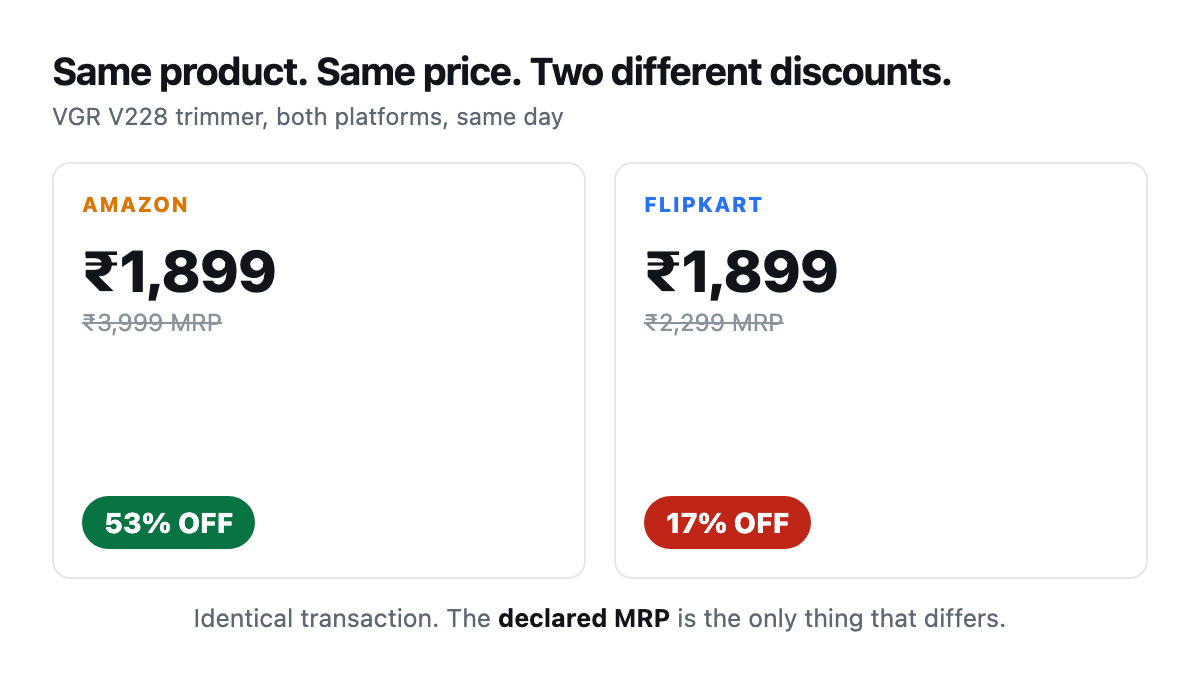
From late August to 21 September 2026, a VGR V228 beard trimmer sold for ₹1,899 on Amazon. The same trimmer, same manufacturer model code, sold for ₹1,899 on Flipkart. Same price, same days.
The Amazon listing showed 53% off. The Flipkart listing showed 17% off.
| Amazon | Flipkart | |
|---|---|---|
| Selling price | ₹1,899 | ₹1,899 |
| Declared MRP | ₹3,999 | ₹2,299 |
| Advertised discount | 53% off | 17% off |
Both listings show the price correctly. They show two different MRPs for one physical object, and only one of them can be right.
Prices have moved since. Today's figures are on our VGR V228 page.
What is MRP, exactly?
Maximum Retail Price is a declaration required under India's Legal Metrology (Packaged Commodities) Rules. The manufacturer prints it on the pack, and it is the highest price at which that item may lawfully be sold, inclusive of all taxes.
The part that matters here: MRP is a property of the product, not of the shop.
A retailer can discount as deeply as it likes below the MRP. Two retailers can charge completely different prices for the same item, and that is ordinary competition. What neither can sensibly do is publish two different maximum retail prices for the same pack, because the manufacturer only declared one.
Why does the discount change when the price doesn't?
Because the badge is arithmetic performed on the MRP, not a statement about value:
discount % = (MRP − selling price) ÷ MRP
Hold the selling price still and move the MRP, and the badge moves by itself:
| Declared MRP | Selling price | Badge shown |
|---|---|---|
| ₹3,999 | ₹1,899 | 53% off |
| ₹2,999 | ₹1,899 | 37% off |
| ₹2,299 | ₹1,899 | 17% off |
Three very different-looking offers. One identical transaction.
This is why the discount percentage is close to useless as a comparison tool between platforms. It is worked out from the MRP on the listing, not from any earlier selling price.
How often does this happen?
We match listings across Amazon, Flipkart and Nykaa by brand and manufacturer model code, then compare the MRP each platform declares. As of the current dataset:
- 47 products carry a different declared MRP on Amazon and Flipkart
- 19 of those sell at an effectively identical price, so the only thing separating the two listings is the badge
Some of the same-price cases:
| Product | Price on both | Amazon listing | Flipkart listing |
|---|---|---|---|
| VGR V228 | ₹1,899 | 53% off | 17% off |
| Philips X3063 | ₹2,678 | 31% off | 43% off |
| Vega VHBT03 | ₹1,649 | 8% off | 25% off |
| Havells HD3151 | ₹1,099 | 22% off | 35% off |
| Vega VHCH05 | ₹849 | 15% off | 29% off |
It is not confined to cheap products either. In mid-September 2026 the Philips HX6877 electric toothbrush was declared at an MRP of ₹49,641 on one platform and ₹37,211 on the other, a gap of ₹12,430 in the stated legal maximum price of a single item.
The full list, which changes as prices move, is in the MRP mismatch report.
Is this illegal?
We do not judge whether any listing breaks a rule. That is a question for a regulator with investigative powers, not for a dataset built by reading public pages. Our data only shows where two listings disagree.
What this data proves, and what it doesn't
Being precise here matters, so:
It does show that at least one of the two declared MRPs is wrong for every product on our list. A product cannot have two maximum retail prices. That follows from the definition, not from any assumption about behaviour.
It does not show which platform is wrong. With two sources and a disagreement, you know one is incorrect, but not which. Where a third platform lists the same item we can sometimes identify the outlier by majority; with two, we say nothing.
It does not establish intent. An MRP can be stale, left over from an older pack after a revision. It can be a variant mismatch, where a listing is really a slightly different SKU. It can be a value a seller typed once and nobody ever corrected. All three produce exactly the signal we measure.
We also exclude multipacks. A twin-pack legitimately carries roughly twice the single-unit MRP, and counting that as a mismatch would simply be an error on our part.
How to check any listing yourself
You don't need our data to do this:
- Find the model code, not the marketing name. It is usually in the title or the specifications table, for example BHD356/10, V228 or HD3151. Marketing names vary between platforms; model codes don't.
- Search that code on the other platform. This is the step that makes the comparison valid. Matching on the product name alone will pair you with the wrong variant surprisingly often.
- Compare the selling prices first. That is the only number describing what leaves your account.
- Then compare the struck-through MRPs. If they differ, the discount percentages are not comparable between the two listings, and at least one is built on a wrong number.
The practical takeaway
Ignore the badge. Compare the rupee price.
A listing showing 70% off at ₹2,400 is worse than one showing 10% off at ₹1,900, however the two pages present themselves. The percentage describes a claim about the past; the price describes your actual transaction.
If you would rather have it checked for you, every product page on this site shows both platforms' declared MRP side by side and flags the ones that disagree. You can also browse by category: trimmers, hair dryers, straighteners, or read how we score products, which weighs discount accuracy as one of three components.
Figures in this article reflect our dataset on the published date and change as retailers update prices. The MRP mismatch report is always current.