
From 1 January 2027, when an online shop in India announces a price cut, it has to show a second price beside it: the lowest price the product was offered at in the previous 30 days. The rule is new, so we tried it early, on this sale's prices.
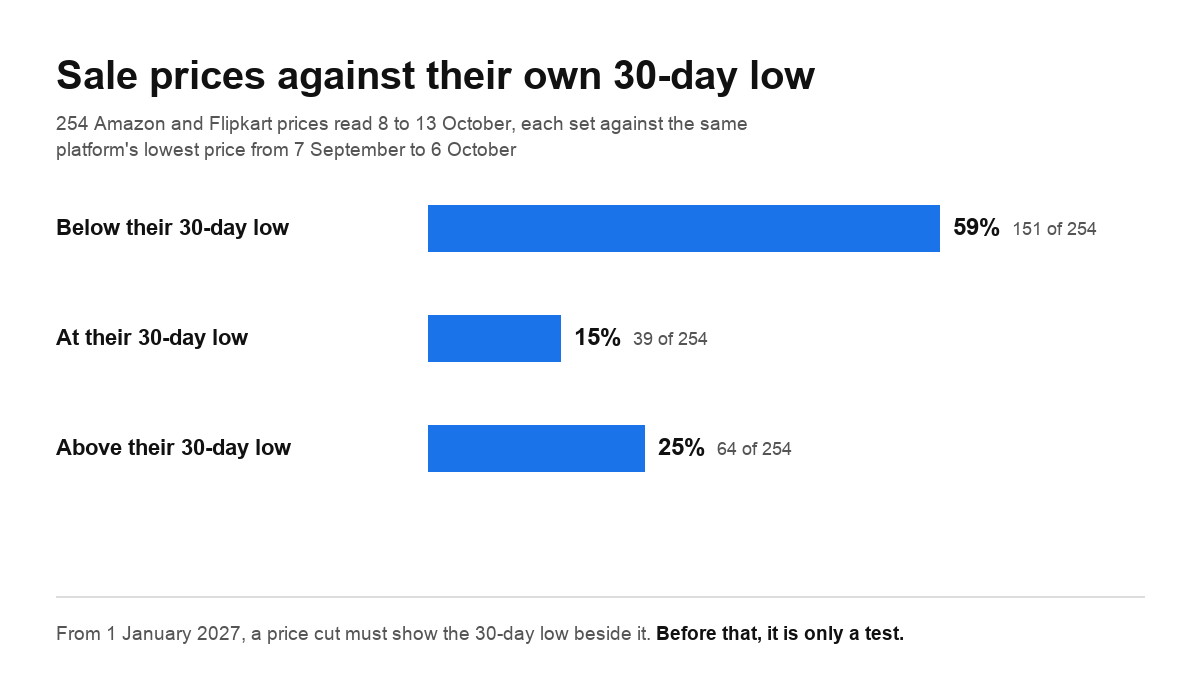
We took 254 Amazon and Flipkart prices read between 8 and 13 October and set each one against its own lowest price on the same platform from 7 September to 6 October. 151 of them, 59%, are below that 30-day low. 39 are at it, and 64 are above it.
What does the new rule say?
The Department of Consumer Affairs amended the Consumer Protection (E-Commerce) Rules on 10 September 2026. The changes apply from 1 January 2027.
The part about prices is short. A platform that announces a price reduction must show the reduced price together with a prior price, and the prior price is the lowest price at which the product was offered during the 30 days before the reduction was announced. That's how it was reported by Moneylife and Business Standard.
The same amendment covers search rankings, sponsored listings, dark patterns and complaints. This piece is only about the price part.
What isn't clear yet is how platforms will show it on a listing, and whether the MRP will stay beside the price as well. The MRP is still the price printed on the pack, so we'd expect it to stay. We'll update this page when the display is known.
How we tried it
A series is one product on one platform. We looked at Amazon and Flipkart only, and compared Amazon with Amazon and Flipkart with Flipkart.
- The sale price is the latest reading since each sale opened: 8 October on Amazon, 9 October on Flipkart, up to 13 October. Where a product had more than one listing, we took the lowest in-stock price that day.
- The 30-day low is the lowest daily price on the same platform from 7 September to 6 October, the day we froze our second pre-sale record. A series needed readings on at least 4 of those days. The typical series had 8.
- Below means at least 1% under the 30-day low, above means at least 1% over it, and anything in between counts as at it.
- Packs and bundles are left out.
What we found
| Prices | Share | |
|---|---|---|
| Below their 30-day low | 151 | 59% |
| At their 30-day low | 39 | 15% |
| Above their 30-day low | 64 | 25% |
For the 151 below it, the typical sale price is 9% under the 30-day low.
By category:
| Category | Prices | Below | At | Above |
|---|---|---|---|---|
| Trimmers | 81 | 45 | 15 | 21 |
| Hair dryers | 68 | 45 | 6 | 17 |
| Straighteners | 44 | 30 | 5 | 9 |
| Everything else | 61 | 31 | 13 | 17 |
Two numbers for one price
Today a listing shows a discount worked out from the MRP. The new rule adds a second reference: what the product actually sold for recently.
They measure different things. The MRP is the most the product can be sold for, by law. The 30-day low is the cheapest it has recently been sold for. Neither is wrong, and they'll usually give different numbers for the same price.
On these 254 prices, the typical discount against the MRP is 36%. Against their own 30-day low, the typical difference is 4%. That gap is the reason the rule exists: the second number tells a shopper how this price compares with last month.
Four examples
All four are single listings with a title that matches the model, read on 13 October.
| Product | Sale price | MRP | 30-day low |
|---|---|---|---|
| Philips MG3927 trimmer, Amazon | ₹1,199 | ₹2,045 | ₹1,499 |
| Nova NHP8215 hair dryer, Flipkart | ₹998 | ₹1,699 | ₹1,224 |
| Havells HS4501 crimper, Amazon | ₹1,499 | ₹2,545 | ₹1,499 |
| Agaro MT7007 trimmer, Flipkart | ₹789 | ₹1,199 | ₹789 |
The first two are 20% and 18% under their 30-day low. The last two are at it: they had already reached that price in the weeks before the sale, so there's no fresh cut against the 30-day low to show.
Why would a sale price be above its 30-day low?
64 prices are. That has ordinary causes, and none of them is a finding against anyone:
- Early deals. Flipkart's early deals have run since 24 September, and some products had sale-level prices inside our 30-day window.
- A short dip. One day at a low price is enough to set the 30-day low, even if the usual price was higher.
- More than one seller. We take the lowest in-stock offer on each day, and the seller offering it can change.
- Readings in rotation. Each product is read on some days, not every day.
What this does not tell you
The rule isn't in force yet. Nobody has to show a 30-day low today. This is a test of the measure, not a check on anyone.
Our window is fixed. The rule counts 30 days back from when a cut is announced. We used one window, 7 September to 6 October, for every product.
Our 30-day low may be higher than the real one. We don't read every product every day, so a low price on a day we didn't read is missing.
Bank offers and coupons are not included. They're on top of the listed price.
It says nothing about which product to buy. A price below its 30-day low is a statement about its own recent history, not about value or quality. Our guide on how to check whether an online discount is real covers the rest, and the pre-sale price record lets you look up any product we track.
Prices read up to 13 October 2026, against 7 September to 6 October on the same platform.