
A discount badge is a claim about the past: it says the product used to be worth more. Nothing on the page proves that. The percentage is calculated from the MRP the listing declares, and if that figure is out of date or wrong, the badge can be large while the saving is small.
Here is how to check a listing yourself in about a minute.
Step 1: Find the model code, not the marketing name
Look for the manufacturer's code in the title or the specifications table, for example
BHD356/10, V228 or HD3151. It is the only reliable identifier a product
carries.
Marketing names drift between platforms. The same trimmer might be listed as Beard Trimmer for Men, 60 Min Runtime, Cordless on one site and Professional Trimmer Kit on another. Match on those and you will constantly compare two different products and conclude one is a bargain.
Model codes do not drift. If you take one habit from this article, take this one.
Step 2: Compare the selling price across platforms
Search the model code on the other major platform. Compare the rupee price, not the percentage.
This sounds obvious and it is the step most people skip, because the badge is large and colourful and the price is not.
Step 3: Compare the struck-through MRPs
Now look at the crossed-out price on both listings.
If they differ, the two discount percentages are not comparable, and at least one of them is calculated from a wrong number, because a product has only one maximum retail price. We cover why this happens in why the same product shows different MRPs on Amazon and Flipkart.
A worked example. From late August to 21 September 2026, the VGR V228 trimmer sold at ₹1,899 on both platforms:
| Amazon | Flipkart | |
|---|---|---|
| You pay | ₹1,899 | ₹1,899 |
| Declared MRP | ₹3,999 | ₹2,299 |
| Badge | 53% off | 17% off |
Identical transaction. The badge differs by 36 percentage points. Prices have moved since; the VGR V228 page shows today's figures.
Step 4: Check whether the price actually moved
A genuine discount usually leaves a trace: the price was higher recently and is lower now.
Our product pages plot MRP against selling price over time, from the observations we have recorded. If a product showing 60% off has sat at the same rupee figure every day we have watched it, the badge is describing a reference price, not a price drop.
Be fair to the data, though. Our history starts when we began tracking a given product, and for many that is recent. A short record cannot tell you what happened last year. Treat a flat line over two weeks as suggestive, not proof.
Step 5: Avoid three common comparison mistakes
Three things that make a comparison look worse than it is:
Multipacks. A twin-pack legitimately carries roughly twice the single-unit MRP. Compare a two-pack against a single and you will see a mismatch that is not really there. We exclude these from our own reports for exactly this reason.
Variants. Colour, wattage, blade count, bundled accessories. A close model
code is not the same model code. HD3151 and HD3161 are different products
with different prices.
Stale listings. An MRP can be left over from an older pack after a revision. That is an old number nobody updated, and from outside it looks the same as any other mismatch.
Step 6: Sanity-check against the category
If a product claims to be 70% off and the price is still above what similar products cost, the badge is not a good guide to value.
Browsing a category such as trimmers, hair dryers, shavers, sorted by actual price, tells you more about whether ₹1,899 is good than any badge on a single listing.
The one-line version
Compare the rupee price. Ignore the percentage.
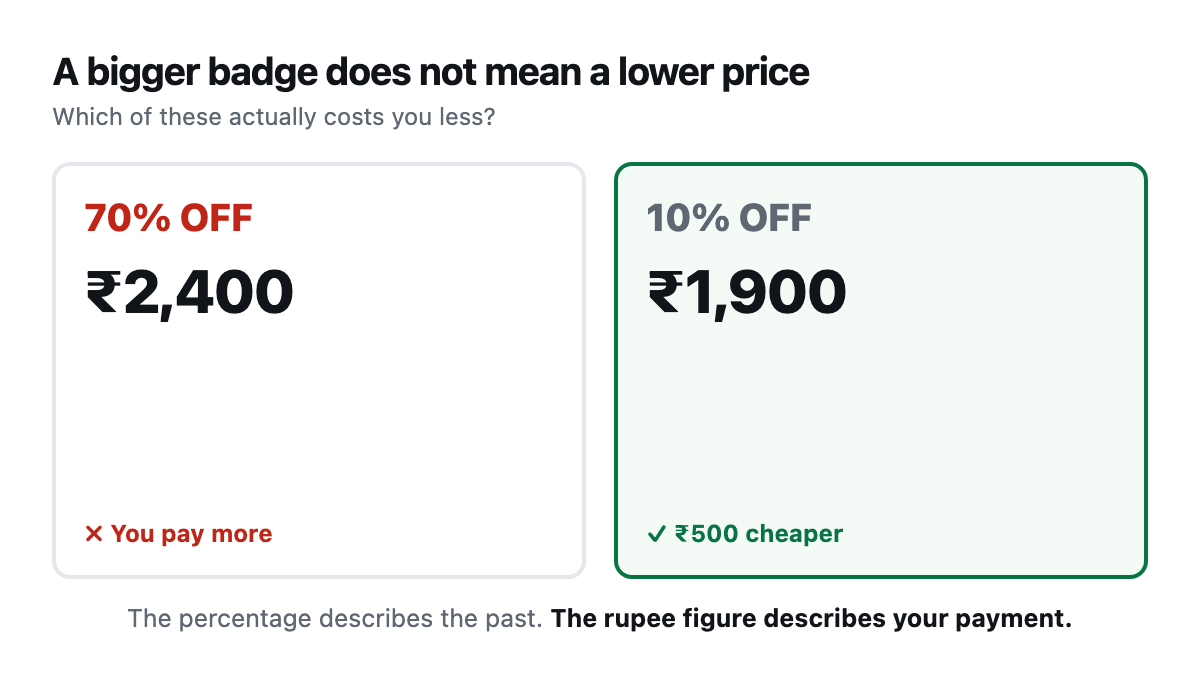
A listing showing 70% off at ₹2,400 is worse than one showing 10% off at ₹1,900. The percentage describes a claim about the past. The price describes what leaves your account.
What we can and cannot tell you
We match listings across Amazon, Flipkart and Nykaa by model code and publish what each platform declares. Where two platforms disagree about an MRP, we flag it. In the August 2026 edition that was 54 products, of which 15 sold at effectively the same price on both.
What we cannot tell you is which listing is wrong, or why. An old MRP, a variant mix-up and a typing error all look the same from outside, and we are reading public pages, not auditing anyone's records.
The MRP mismatch report has the current list, and how we score explains how discount accuracy feeds into the rating we publish.
Figures reflect our dataset on the published date and change as prices move.