
Amazon's Great Indian Festival opens on Thursday 8 October, with Flipkart's Big Billion Days following on Friday 9 October. Flipkart Plus and Black members get access a day early.
Tomorrow evening we freeze a second record of what products cost. This is the method, written down a day ahead, so nobody can say we tuned it after seeing the sale.
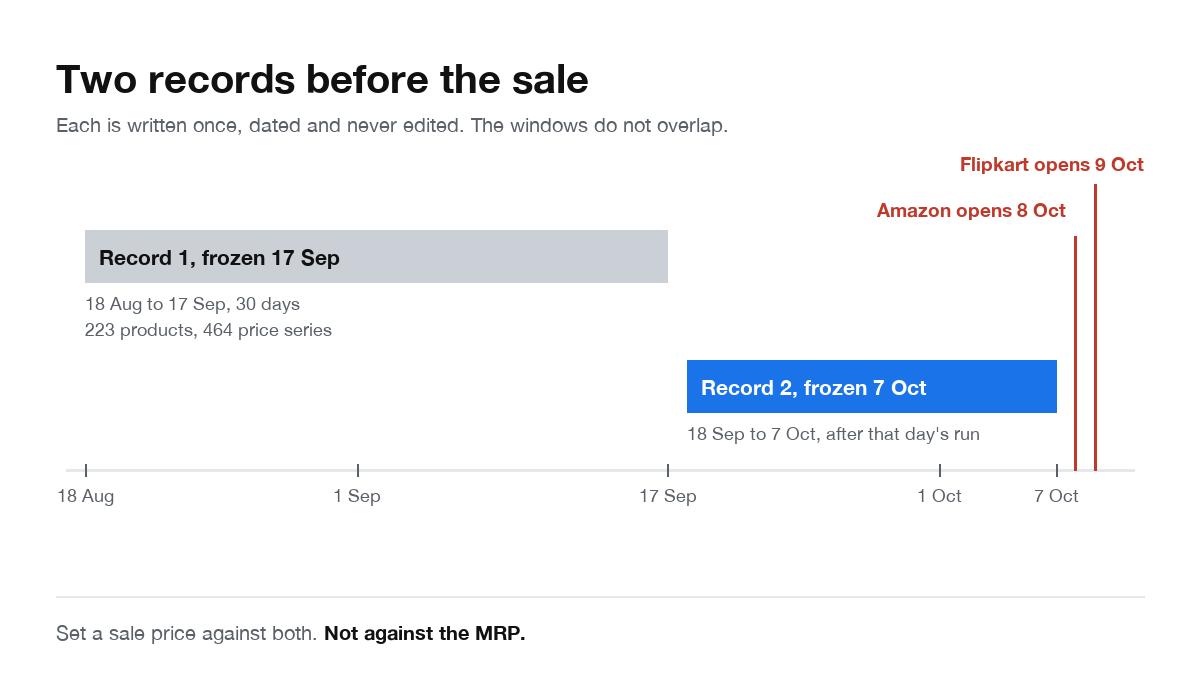
Correction, 7 October 2026. We froze the second record on 6 October, not 7 October as this page first said. Prime members got early access to the Amazon sale on 7 October, so 6 October was the last clean day before any sale price appeared. The record covers 17 September to 6 October, so it shares one day, 17 September, with the first record. The timeline below and the dates in the section on the second record show the original plan. We've left them as written, because this page promised not to adjust the method afterwards. The record itself is on the pre-sale prices page, and what it shows is in before the sale, most prices stayed put.
Why a record at all
During a sale every listing shows a discount, and the number next to it is measured from an MRP the listing declares. As we found in the September index, two platforms often declare two different ones for the same product.
The most reliable yardstick is what the product actually cost before. That's something nobody can check after the fact unless they were watching, and a live database moves every day. So we write the record down once, give it a date, and leave it alone.
The first record
We froze it on 17 September. It covers 18 August to 17 September and holds 223 products across 464 price series. A series is one product on one platform, and it needs at least three readings to count. Amazon is compared with Amazon and Flipkart with Flipkart, never one shop's sale against another's normal price.
It has already been corrected once, and the correction is the point. On 21 September we found that three series had each picked up a listing for a different product, and withdrew them: a hair dryer and a straightening brush sold together, a straightening brush listed under the dryer, and a Philips BT3325 sitting under the BT3303. We didn't edit the file. We left it exactly as captured and published a separate corrections file giving the reason for each. Anyone holding a copy can see precisely what changed.
That's the rule for the second record too.
The second record
When. Wednesday 7 October, after that day's collection run has finished and before midnight. Earlier would miss the last pre-sale day. Later and Amazon's sale is open.
What it covers. 18 September to 7 October. It starts the day after the first record ended, so the two don't overlap.
What it answers. The first record shows the prices of mid August to mid September. The second shows the weeks right before the sale. Between them you can tell whether a price went up just before the sale and then came back down inside it, which looks like a deal against its badge and like nothing against its own recent history. You can also tell whether it fell before the sale and stayed down, which means part of the discount was already there.
What happens to it. It's written once, committed, and published next to the first. If a series turns out to be wrong, it goes in a corrections file with the reason. The record itself is never rewritten.
Where things stand today
The pre-sale page already compares today's prices with the first record. As of 6 October, of the 422 prices it can compare, 42 are below anything we recorded between 18 August and 17 September and 79 more are below their usual price. 195 are unchanged, and 106 cost more than their usual price.
So more have fallen than risen, 121 against 106, and nearly half haven't moved. Neither direction is a finding against anyone. As we said when we first looked at this in what prices did before the sale, a price can rise because stock ran low, a seller left, an offer ended or costs changed, and from outside they all look the same.
What a record cannot do
It can't see before 10 August. Our price history starts there. A discount that has been standing since June reads as no discount in our method, because we never saw the higher price.
It's a record and not a verdict. It says that on a given date we observed a price. It doesn't say anyone behaved badly.
It isn't the whole catalogue. Products are refreshed in rotation, so a series with too few readings is left out rather than guessed at.
It can have errors. The first one did. That's why the corrections file exists, and why we'll publish any we find in the second.
What to do with it
On Thursday, take the sale price and set it against both records, not against the MRP printed beside it. If a product's price rose between the first record and the second, the sale price has a higher bar to clear before it counts as a deal. If it fell in between, some of the discount was already there.
The test we apply to our own deals page is written out in what counts as a real deal, and the live comparison with the first record is on the pre-sale prices page.
Written on 6 October 2026, the day before the second record is frozen. First record: 18 August to 17 September 2026.