
Correction, 12 October 2026. The figures in this article were wrong. We ran a stand-in for the deals page's test, not the test itself. The stand-in took each day's lowest reading across platforms, where the page uses each product's cheapest current offer. Run properly on the readings we held on 2 October, 232 products had a current price, 68 were at their lowest recorded price, 124 passed the test and 108 did not. We had said 223, 44, 103 and 120. We have also removed the table of products furthest below their usual price, and added a limit of the test that we hadn't described. The text below uses the corrected figures.
Amazon's Great Indian Festival opens on 8 October and Flipkart's Big Billion Days on 9 October. Our deals page will fill up next week, and a page that calls things deals during a sale is worth very little unless you know what it refuses to call a deal.
So here is the test, in full, six days before it matters. Writing it down now means it can't be quietly adjusted once the discounts start.
The test never looks at the MRP
This is the whole of it. A product qualifies on what it has charged, not on the MRP a listing shows.
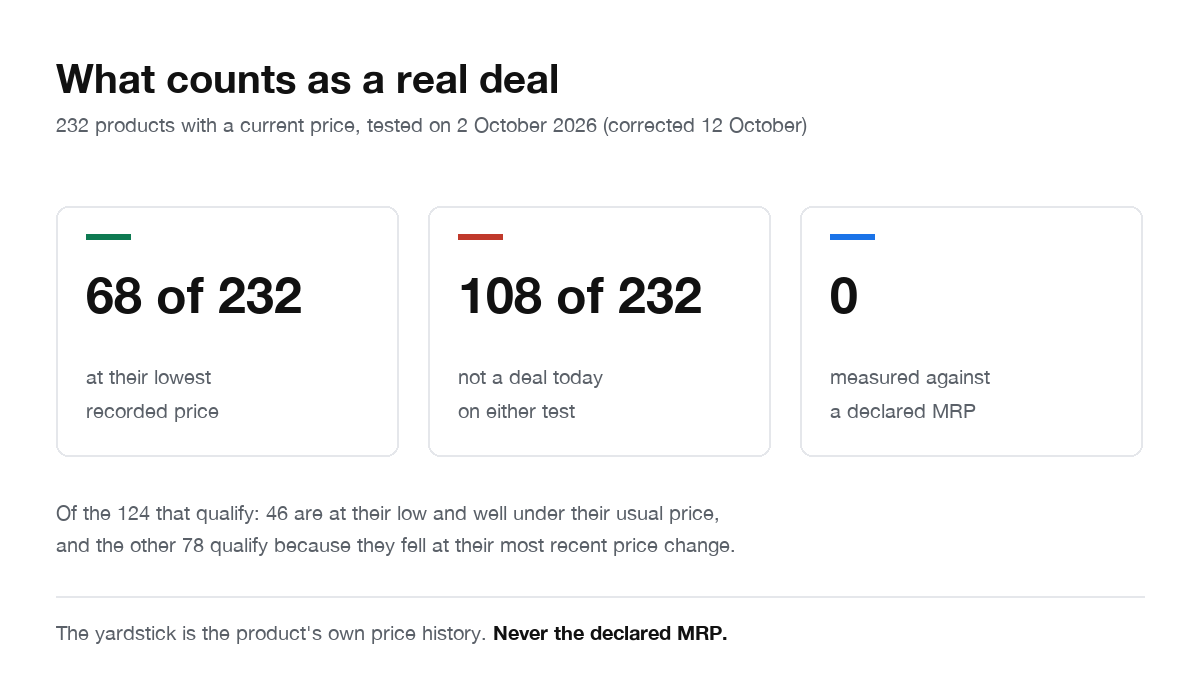
There are two ways in.
It is at its lowest recorded price, and it is meaningfully below its own usual price. Both halves matter, and the second one is there because of a mistake worth admitting: a product whose price never moves is trivially at its own low every single day. So the price has to actually travel, by more than 4% across its recent readings, before being at the bottom of that range means anything. Recent means its latest 40 readings across platforms, which is about three weeks for most products.
Or it just fell, by 3% or more at its most recent price change.
That is it. No declared MRP enters the calculation at any point.
Why the test leaves out the MRP
Yesterday's September index found 74 products where the Amazon and Flipkart listings showed different MRPs for the same item. On 15 of them the selling price was within ₹5 and only the crossed-out figure differed.
When two listings show different MRPs, a percentage based on the MRP can't be compared between them. Badges also tend to grow during a sale, so past prices are a steadier guide.
The numbers from 2 October
232 single-unit products had a current price on 2 October, and 231 of them had at least seven days of readings. Running the test on the readings we held that day:
| Products | |
|---|---|
| At their lowest recorded price | 68 |
| At their low and well below their usual price | 46 |
| At their low, but barely below usual | 22 |
| Fell at their most recent price change | 104 |
| Qualify overall | 124 |
| Do not qualify | 108 |
The 22 at their low but barely below usual are at the bottom of a range that has otherwise sat close to that price, so the dip is small and they don't qualify on that route. 78 of the 124 qualify only because they fell at their most recent price change, which is the weaker of the two routes, for the reason given under what the test cannot do.
What we took out
An earlier version of this section listed the six products furthest below their usual price. We have removed it. The usual price is the middle of each day's cheapest reading across platforms, and platforms are read on different days, so a day on which only a dearer platform was read pushes the usual price up. The Havells HS6000 showed ₹3,795 as its usual price in that table. On Amazon it was ₹2,099 in our August record and ₹1,499 in the second.
The part that matters next week
If something is already at its lowest recorded price today, then a sale badge on 8 October has to beat today, not beat the MRP. A product that is ₹1,499 now and ₹1,499 during the sale with a large badge on it has not changed in price, whatever badge it shows.
That is the one check worth doing on sale day, and it takes a few seconds. Open the product's page here, look at what it has actually charged, and compare the sale price with that line rather than with the crossed-out number next to it.
What the test cannot do
It has a short memory. The test looks at each product's latest 40 readings, about three weeks for most, and our price history starts on 10 August 2026. A discount that has been standing longer reads as no discount at all in this method, because we never saw the higher price. Nobody should quote these figures as all time lows, and our pages say the number of days behind each claim.
Short histories are thin. The page only says how many days a low covers once a product has seven days of readings. 231 of the 232 products here had that.
A recent drop can be a change in which platform was read last. The test compares a product's cheapest current offer with the cheapest reading on earlier days, across platforms, and platforms are read on different days. Of the 104 products flagged as a recent drop on 2 October, 53 had no fall of 3% or more on the platform that held their cheapest offer. We haven't changed the rule. The same-platform check in our day five piece compares Amazon with Amazon and Flipkart with Flipkart, and doesn't have this problem.
It cannot see why. A price falls because stock is clearing, because a seller left, because of a genuine promotion, or because of an error. All four look the same from outside, and we don't guess between them.
Packs are excluded. A twin pack carries roughly double the single unit price by design, so counting it would put nonsense on the page.
The page is also ranked and capped. The deals page shows the strongest 48 and applies a quality score on top of this test, so a product can pass the history test and still not appear.
The short version
A real deal is cheaper than the thing has actually been, not cheaper than the MRP a listing shows. On 2 October, 124 of 232 passed the test, 68 of them at their lowest recorded price, and 108 did not.
The deals page applies it live, and the full scoring method is published. If you want the reasoning behind ignoring the badge, that is in is the discount real.
Tested on 2 October 2026 across every product with seven or more days of recorded prices.