
Prime members got early access to Amazon's Great Indian Festival today. Everyone else gets it tomorrow, 8 October, and Flipkart's Big Billion Days opens on 9 October.
We now hold two frozen records of what these products cost before any of that. The first covers 18 August to 17 September. The second covers 17 September to 6 October, the weeks right before the sale. Set side by side, they answer one question: did prices move in the run-up to the sale?
Mostly, no.
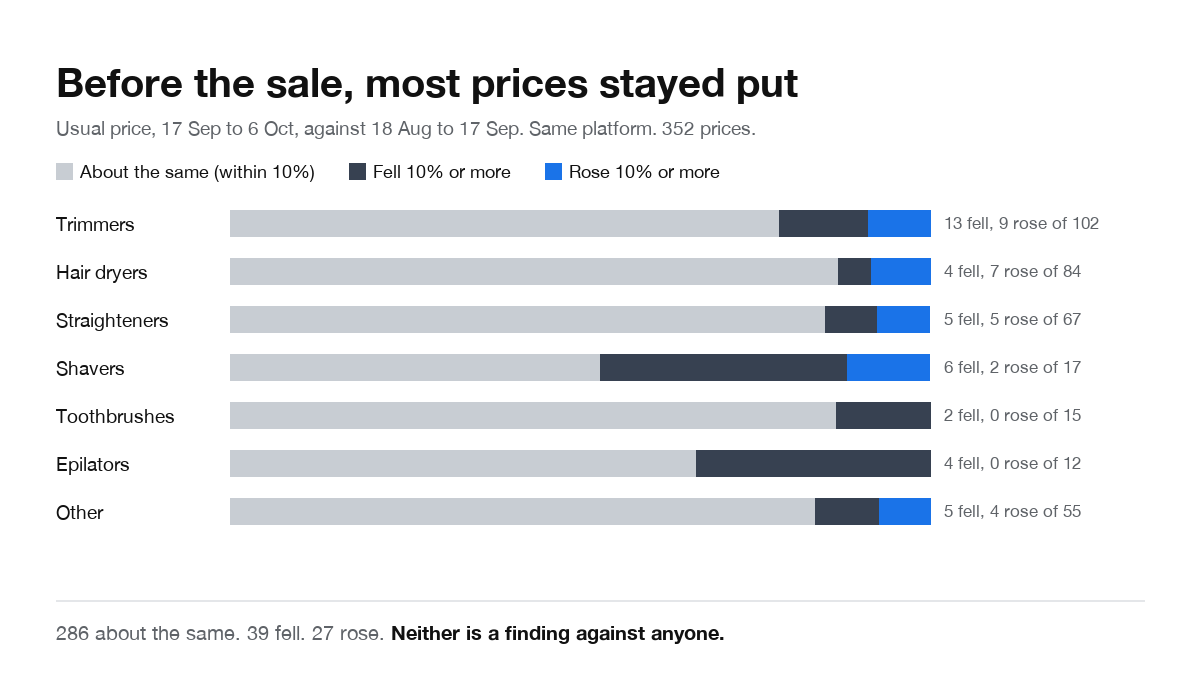
The numbers
352 prices appear in both records. Each one is a single product on a single platform, so Amazon is compared with Amazon and Flipkart with Flipkart. For each, we took the usual price, the middle of everything we recorded, in each window.
| Usual price before the sale, against August | Prices |
|---|---|
| About the same, within 10% | 286 |
| Fell by 10% or more | 39 |
| Rose by 10% or more | 27 |
Of the 286, 147 had exactly the same usual price in both records. That's roughly two in five of everything we compared, unchanged to the rupee.
The 39 falls cover 36 products and the 27 rises cover 27. The typical move was about 15% either way. So more prices came down than went up, and the ones that moved did so by similar amounts.
Two examples, one each way
A Philips NT3650 trimmer on Flipkart had a usual price of ₹1,490 across 10 readings in the first record. In the second, across 11 readings, it was ₹999.
A Vega VHDH20 hair dryer on Flipkart had a usual price of ₹748 across 17 readings in the first record. In the second, across 6 readings, it was ₹994.
We picked these two because both have plenty of readings. The very largest moves in either direction are where a listing is most likely to have changed under us, so we don't lead with them.
By category
The split is in the chart above. Shavers and epilators moved most, and mostly down. No toothbrush or epilator rose by 10% or more. Trimmers, hair dryers and straighteners were steadiest, with about eight in ten or more staying within 10%.
These are small groups. Six shavers falling is a count, not a trend, so read it as what happened to these listings and nothing wider.
What it means for a sale price
A sale price is easier to judge when you know what came before it. With two records you can check it against both.
Say the trimmer above shows ₹999 in the sale with a large badge. That's what it has cost for the last three weeks, so the badge isn't new money off. Now say the dryer shows ₹899. That's below its recent ₹994, and still above the ₹748 it sat at in August. Both readings are true. Which one you care about is up to you.
Every product we track has both figures on the pre-sale prices page, marked rose or fell where the move was 10% or more.
What this does not show
It doesn't show why. A price moves when a seller joins or leaves a listing, a bank offer starts or ends, stock runs low, or a new batch arrives. From outside they look the same, and we don't guess.
It isn't every day. Products are checked in rotation. The typical series has 7 readings in the first record and 6 in the second.
The records share one day. The first ends on 17 September and the second starts on it. We froze the second a day earlier than planned, because early access opened on 7 October. The second record's method page carries the correction.
It's a record, not a verdict. A rise is not wrongdoing and a fall is not proof of a bargain. It shows what we observed and when.
Both records are frozen and free to reuse under CC BY 4.0, from the pre-sale prices page. Figures from the records frozen on 17 September and 6 October 2026.