
A star rating looks like a fact about a product. It is not. It is a fact about a product on one platform, from one set of buyers, at one point in time.
We track the same products across Amazon, Flipkart and Nykaa, matched by manufacturer model code so we are comparing the same physical item. 215 of the 217 products we track carry a rating on more than one platform. They frequently disagree.
The same product, two verdicts
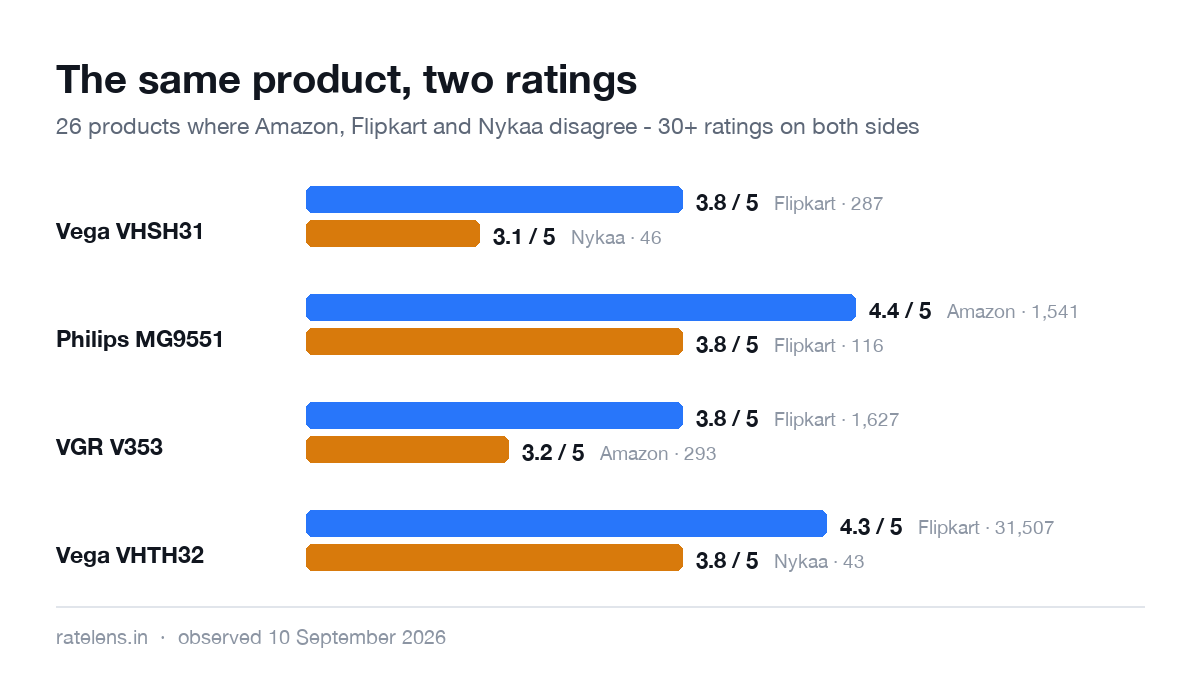
We only counted products with at least 30 ratings on both sides, so a handful of reviews can't manufacture a disagreement. On that rule, 26 products show a real gap.
| Product | Higher | Lower | Gap |
|---|---|---|---|
| Vega VHSH31 | 3.8★ Flipkart · 287 | 3.1★ Nykaa · 46 | 0.7★ |
| Philips MG9551 | 4.4★ Amazon · 1,541 | 3.8★ Flipkart · 116 | 0.6★ |
| VGR V353 | 3.8★ Flipkart · 1,627 | 3.2★ Amazon · 293 | 0.6★ |
| Vega VHSCC07 | 4.0★ Flipkart · 2,210 | 3.4★ Nykaa · 161 | 0.6★ |
The median gap across all 26 is 0.35★. The largest is 0.7★.
That sounds small until you remember how these numbers get used. A 4.4 and a 3.8 sit either side of the line most people use to decide, and they describe the same object.
Nobody wins consistently
If one platform simply had softer reviewers, you could correct for it. It does not work that way.
Across the 26 products, the higher rating sat on Flipkart 15 times, Amazon 9, Nykaa twice. The lower rating sat on Amazon 10 times, Flipkart 10, Nykaa six. Amazon and Flipkart each appear as often on the low side as the high.
There is no platform to trust and no platform to discount. The disagreement is per product.
The number that matters more than the stars
Look at Vega VHTH32: 4.3★ from 31,507 ratings on Flipkart, 3.8★ from 43 on Nykaa.
Both are displayed the same way. One is built on thirty-one thousand opinions, the other on forty-three. A rating from 43 people can move by a tenth of a star on a bad week.
This is the single most useful habit when reading a rating: read the count before the stars. A 4.6 from 50 buyers tells you far less than a 4.1 from 5,000, and the two look the same on the page.
It is also why our own scoring shrinks thin samples toward neutral rather than taking them at face value.
Averages hide the shape
An average flattens the distribution. Two products can both average 4.0. One gets there because most buyers gave it a 4, the other because a lot gave 5 and a lot gave 1.
Of the 26 divergent products, 22 also showed a different share of 1-star reviews between platforms. Philips MG9551 differs by 16 percentage points. The stars move a little; the proportion of people who actively regretted buying moves a lot.
If a platform shows you the rating breakdown, the 1-star bar is usually more informative than the average above it.
Why the same product gets different ratings
We report the divergence. We do not claim to know which figure is right, and neither should anyone else. But the plausible causes are ordinary:
- Different buyers. Platforms attract different audiences with different expectations of the same item at the same price.
- Different delivery experience. A lot of one-star reviews are about the parcel, not the product.
- Different sample size and age. A rating built over three years and one built over three months are not the same measurement.
- Different review prompts. When and how a platform asks affects who answers.
None of that is misconduct. It just means a rating on one platform is a partial view. Checking a second platform gives you the fuller picture.
How to read a rating, in four steps
- Check the count first. Under a few hundred, treat the average as a hint rather than evidence.
- Check a second platform. If the same product is rated elsewhere, a gap is a signal to look closer.
- Look at the 1-star share, not just the average.
- Ignore ratings on a different variant. Colour and pack-size variants often pool reviews from products you are not buying.
You can see all 26 products where ratings disagree, with counts and platforms, in our ratings that disagree report. Every product page on Ratelens shows the per-platform rating side by side, so you can check any product we track without doing this by hand.
Figures observed across Amazon, Flipkart and Nykaa and current as of 10 September 2026. Ratings change as new reviews arrive, and the numbers on the site are the ones we last recorded. We report where platforms disagree; we do not claim to know which rating is correct.