
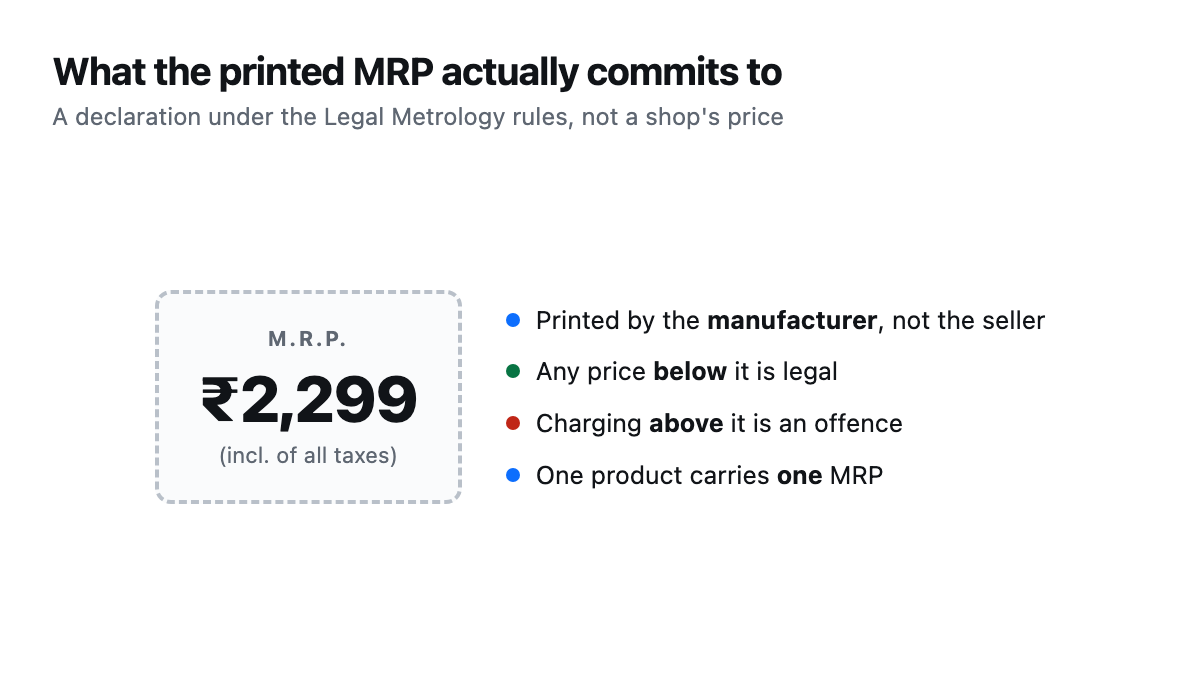
Maximum Retail Price is not a suggestion, a list price, or a number a shop chooses. It is a declaration the manufacturer, packer or importer is legally required to print on a pre-packaged commodity, and it sets the highest price at which that pack may lawfully be sold in India, inclusive of every tax.
That single fact explains most of what confuses people about discounts online.
Where the requirement comes from
MRP declaration sits under the Legal Metrology Act, 2009 and the Legal Metrology (Packaged Commodities) Rules, 2011, administered by the Department of Consumer Affairs.
The Rules set out what a pre-packaged commodity must declare on its label. Among other things, that means the name and address of the manufacturer or packer, the net quantity, the date of manufacture, and the retail sale price.
The Rules define that price as the maximum it may be sold for, inclusive of all taxes, and it has to be declared in rupees.
Why the words inclusive of all taxes matter
If a pack declares ₹499 as MRP, ₹499 is the most you can be asked to pay for it. Not ₹499 plus GST. Not ₹499 plus a handling charge that appears at the till.
This is the most commonly encountered version of the rule in daily life, and it is also the version that shows up in enforcement. India's Central Consumer Protection Authority has taken action against online sellers for adding tax at checkout to a price presented as inclusive of taxes, a practice it treats as drip pricing under its dark-patterns guidelines.
Can a shop sell above MRP?
No. The MRP is the ceiling for that pack.
The Legal Metrology Act treats declaration-related offences as punishable, with fines that rise for repeat offences. Its penalty provisions have been amended more than once in recent years, so check the current Act on India Code for the exact figures.
There is a well-known exception at the edges. The Supreme Court has upheld the practice of hotels and restaurants charging above MRP for items such as bottled water, on the reasoning that what is being sold there is a service rather than a packaged commodity over the counter.
Selling below MRP is entirely legal. That is what a discount is. The rule sets a maximum, not a fixed price.
Can the same product have two different MRPs?
This is where the rules speak most directly to what we track on this site.
Rule 18(2A), introduced by the Legal Metrology (Packaged Commodities) Amendment Rules, 2017, prohibits a manufacturer, packer or importer from declaring different retail sale prices on identical pre-packaged commodities where doing so amounts to a restrictive or unfair trade practice, as those terms are understood under consumer protection law.
Three things about that rule are worth reading carefully, because they are routinely flattened in summaries:
- It binds manufacturers, packers and importers, the parties who make the declaration. It is not, on its face, a rule about what a retailer or an online marketplace displays.
- The products must be identical. Different pack sizes, variants or SKUs legitimately carry different prices.
- Enforcement is not automatic. Officers are expected to consider whether the goods are genuinely pre-packaged, genuinely identical, and whether there is justification for the difference.
So when we observe two platforms showing different MRPs for the same model code, the honest description is narrow: at least one displayed figure does not match the pack, because a pack carries one declared price. It does not follow that a manufacturer breached Rule 18(2A), and it does not identify which platform is displaying the wrong number.
We are not lawyers and this is not legal advice. It is a description of what we can and cannot conclude from public listing data.
How MRP relates to the discount you see
Every discount badge online is arithmetic performed on a declared MRP:
discount % = (MRP − selling price) ÷ MRP
The selling price is a fact about your transaction. The MRP is a claim about the pack. If the claim is wrong (stale after a revision, attached to the wrong variant, or simply never corrected), the badge is wrong too, while the price remains perfectly accurate.
That is why a product can cost exactly the same on two platforms and be advertised as 53% off on one and 17% off on the other. We walk through a real case of that in why the same product shows different MRPs on Amazon and Flipkart, and the checks you can run yourself are in how to check whether an online discount is real.
What to do with this
Treat MRP as what it is: a legal ceiling declared by the manufacturer, not a statement of what a product is worth or what anyone previously paid.
Compare rupee prices. Use the MRP to confirm you are not being overcharged above the cap, which does happen, particularly offline. Don't use it to judge whether a discount is generous.
Our MRP mismatch report lists the products where the two largest platforms currently disagree about the declared figure, and how we score explains how that feeds the rating on every product page. If you would rather look brand by brand, each brand page carries its own mismatch count.
This article describes publicly available rules in general terms as of the published date and is not legal advice. For the authoritative text, see the Department of Consumer Affairs and the Legal Metrology Act, 2009.