
No. If a price is printed on the pack as MRP, that is the most you can be charged for it, and every rupee above it is an offence.
That is the short answer. The rest of this explains where the rule comes from, the one exception people run into, and what actually happens if you push back.
What MRP is
Maximum Retail Price is a declaration the manufacturer, packer or importer has to print on pre-packaged goods under India's Legal Metrology (Packaged Commodities) Rules. It is not something the shop decides.
Two things about it matter.
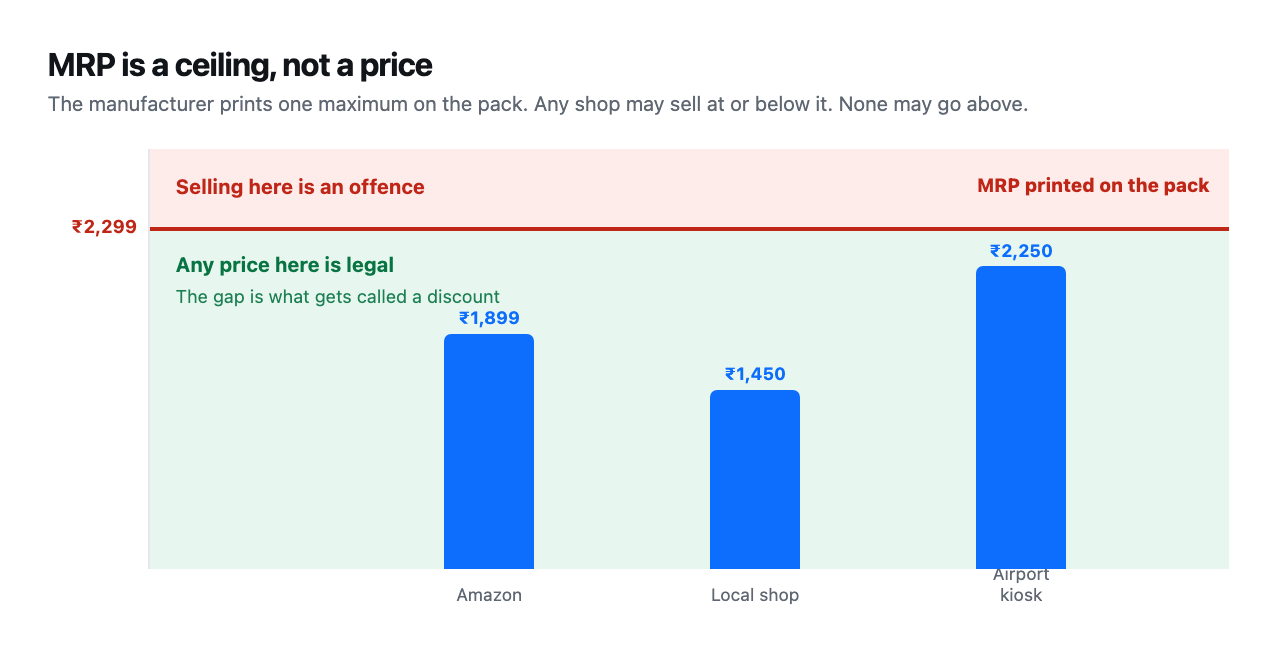
It is a maximum, not a price. Nobody is obliged to sell at MRP. A shop can charge whatever it likes underneath, and that gap is what everyone calls a discount.
And it is inclusive of all taxes. The rules define MRP that way. If the pack says ₹499, then ₹499 is the whole amount. Not ₹499 plus GST, not ₹499 plus a handling charge that shows up at the till.
So why do prices differ between shops?
Because the ceiling is fixed and everything below it is competition.
A trimmer with an MRP of ₹2,299 might sell at ₹1,899 on Amazon, ₹1,450 in a local shop clearing stock, and ₹2,250 at an airport kiosk that knows you have no alternative. All three are legal. Only the last one is close to the line.
This is also why the discount badge tells you so little. It is worked out from the MRP, not from what anyone actually paid before.
The exception you will actually meet
Hotels and restaurants can charge more than MRP for things like bottled water, and the Supreme Court has upheld it.
The reasoning is that what you are buying in a restaurant is a service, not a packaged commodity handed over a counter. You are paying for the table, the staff, the air conditioning. The bottle happens to come with it.
So the ₹80 water at a restaurant is not the same situation as the ₹80 water at a kirana shop. The first is settled law. The second is an offence.
Cinemas, airports and railway stations have argued the same thing with varying success over the years. If you are in a shop rather than a service venue, the ceiling holds.
What happens if a shop charges above MRP
The Legal Metrology Act makes it an offence, with fines that rise for repeat offences. Its penalty provisions have been amended more than once in recent years, so if the exact amount matters to you, check the current Act on India Code rather than a figure quoted in an article.
In practice, most cases never get that far. Pointing at the printed price usually settles it, because the shopkeeper knows the rule as well as you do.
If it does not settle:
- Photograph the pack with the MRP visible, and keep the bill.
- Complain to the state Legal Metrology department. Every state has one and most take complaints online now.
- The National Consumer Helpline (1915) handles this and will route it.
- Consumer court exists for the stubborn cases, though for a ₹30 overcharge nobody sensibly goes there.
The photograph is the part people forget. Without the pack showing the printed MRP, it is your word against theirs.
Online is a different problem
Nothing above applies cleanly to shopping online, because you cannot see the pack. You see the MRP shown on the listing, and you cannot check it yourself.
Sometimes two listings for the same product show different figures. We match the same product across Amazon, Flipkart and Nykaa by manufacturer model code and compare what each one declares. In the August 2026 edition of our index, 54 products carried a different declared MRP on the two largest platforms. In 15 of them the selling price was effectively the same, so the only thing separating the listings was the size of the badge.
They are not spread evenly across brands. Vega has the most of them, with Philips and Havells some way behind. Vega is also the largest brand we track, and a brand with more listings has more chances to appear. The per-brand counts sit on each brand page.
A product has one MRP. When two sites show different ones, at least one of the figures does not match the pack.
To be fair about it, that usually has a dull cause. Stale seller records, old stock carrying a previous pack's printed price, catalogue entries typed once and never revisited. It does not tell you which listing is wrong, or why.
What it does mean is that the percentage is calculated from a number you cannot verify. So use the rupee price.
The short version
- A shop cannot charge above MRP. That is the ceiling.
- It can charge anything below, and often will.
- Restaurants and hotels are the real exception.
- Photograph the pack if you are overcharged. That is your evidence.
- Online, the MRP is a claim rather than something you can see, so compare actual prices instead of percentages.
If you want the mechanics of checking a listing, we walk through it in how to check whether an online discount is real. The legal background sits in what MRP actually means under India's Legal Metrology rules.
General information about publicly available rules, not legal advice. Figures from our dataset reflect the published date; the dated editions of the MRP mismatch report stay fixed.