
Before a sale, the question people really have isn't whether a discount is real. It's whether the dearer one is worth it.
We can't answer that fully, but we can answer a narrow part of it with numbers we already collect. Do the products that cost more get better ratings?
We took every listing we track that carries at least 100 ratings, single units only, and grouped them by what they cost this week. That's 202 listings across 148 products, from Amazon and Flipkart, which are the two platforms that publish a full rating breakdown.
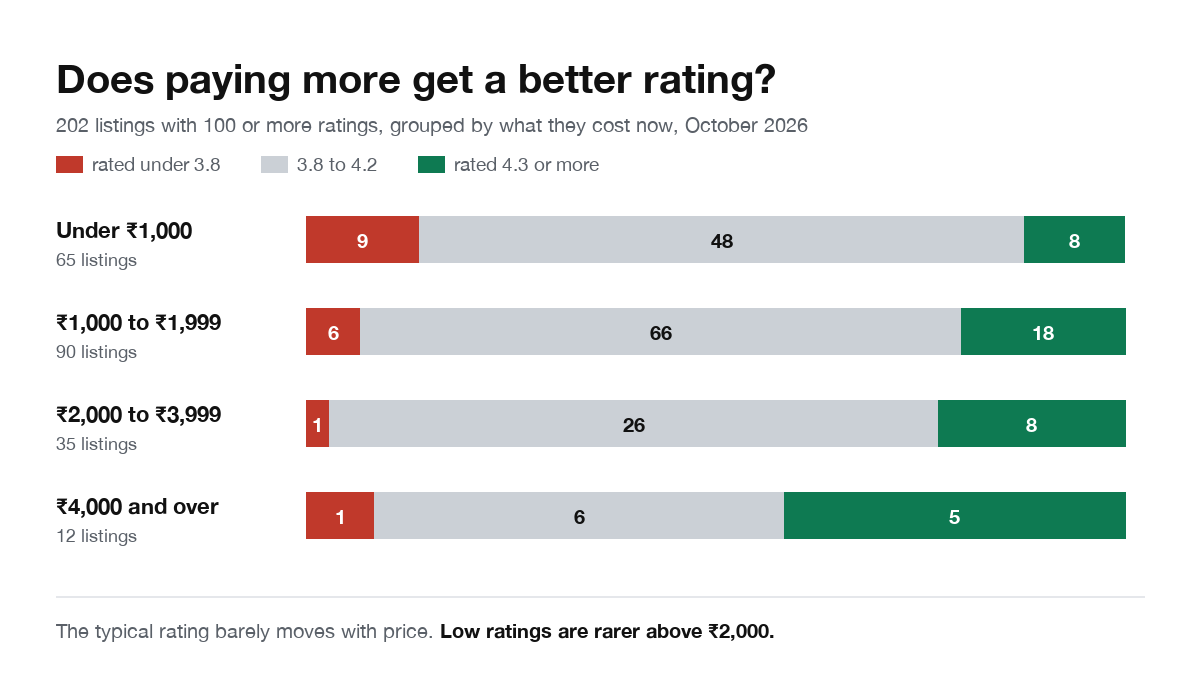
The typical rating doesn't move
The middle listing is rated 4.1 under ₹1,000. It's 4.1 between ₹1,000 and ₹1,999. It's 4.1 between ₹2,000 and ₹3,999. Only above ₹4,000 does it reach 4.2, and that band is 12 listings, so treat it gently.
The share of ratings that are one star doesn't move either. In every band the typical listing has 8% or 9% of its ratings at one star. Paying more didn't thin out the unhappy buyers.
Across all 202, price and rating move together only weakly. On a scale where 0 means no relationship and 1 means they rise in lockstep, it comes out at 0.20. Within trimmers it's higher, 0.44. Within hair dryers it's 0.23, and for straighteners it's close to nothing.
What does change
Two things, and both are about the edges rather than the middle.
Fewer duds. Rated under 3.8, we count 9 of the 65 listings under ₹1,000, and 6 of 90 between ₹1,000 and ₹1,999. Above ₹2,000 it's 2 of 47. Put together, that's 15 of 155 below ₹2,000 against 2 of 47 above it.
More that clear 4.0. The share rated 4.0 or better goes 51 of 65, then 71 of 90, then 32 of 35, then 11 of 12.
Those are small counts, and that's why we're giving the counts and not percentages. Two listings above ₹2,000 are a thin basis for any rule. The honest reading is a lean, not a law: a higher price tilts the odds away from a poor rating without changing what a typical product looks like.
Cheap and well rated is easy to find
Two examples, with the platforms side by side so you can see it isn't one platform's quirk.
The Agaro HC7017 curler is ₹899 on both platforms. Amazon rates it 4.4 from 741 ratings and Flipkart 4.3 from 693, with 5% and 7% of ratings at one star.
The Caresmith FCS0104 massage gun costs ₹899 on Amazon and ₹999 on Flipkart. Amazon shows 4.3 from 831 ratings, Flipkart 4.2 from 4,339.
Dear and poorly rated happens too
The Dr Physio USA 1048 neck massager is ₹2,166 on Flipkart, rated 3.7 from 225 ratings, with 19% at one star. On Amazon the same model is ₹2,154 and rated 3.9 from 2,103, with 12% at one star.
The Vega Professional VPPFS-01 shaver is ₹4,427 on Amazon, rated 3.6 from 177 ratings, with 22% at one star. Flipkart shows 3.9, but from only 45 ratings.
Both are a reminder of something we covered in what a four star average hides: the same product reads differently depending on where you look, so check the breakdown on both platforms before you decide.
Why this is worth knowing in sale week
A sale doesn't change a product's rating. It changes the price you see next to it. A listing that fell from ₹2,400 to ₹1,799 is still the same product with the same 3.7 stars.
So the useful habit in sale week is to separate the two questions. Whether it's cheap is one question, and the real deal test answers it. Whether it's any good is another, and the breakdown under the rating answers that. A large discount on a poorly rated product is just a cheaper way to buy the same problem.
What this does not show
Price bands mix categories. Trimmers, hair dryers and straighteners make up most of every band, but the mix shifts a little, and the top band has 3 shavers in its 12. That's why we also looked inside categories, and trimmers show the clearest pattern.
Prices are this week's. Ratings built up over months, at prices that were sometimes different, and some of today's prices are early sale prices.
It leaves out anything under 100 ratings. New products, and the many that simply aren't bought much, aren't here. That skews the sample toward products that have already survived.
A rating can't separate the product from the delivery. A damaged parcel, a wrong colour and a faulty unit all land on the same bar.
The top band is 12 listings. One product moving would change its row.
One product can appear twice, once for each platform that carries it. That's why 202 listings come from 148 products.
The short version
Spending more doesn't make the typical product better rated, and it doesn't reduce the share of unhappy buyers. It does make a poor rating less likely: 2 of 47 above ₹2,000, against 15 of 155 below. Check the one star bar before you pay extra, because the price alone won't tell you.
The live ratings for every product are on its page, and the method for reading them is in how to read product ratings.
Rating breakdowns and prices read on 4 October 2026, listings with 100 or more ratings, single units only, from Amazon and Flipkart.