
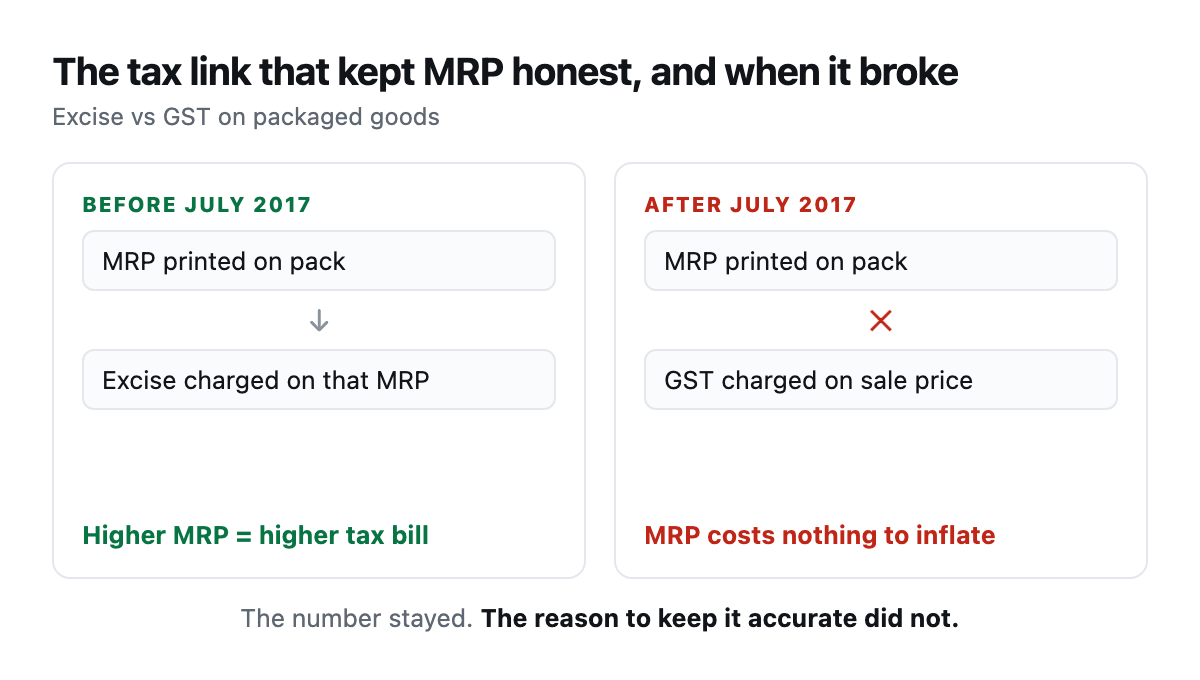
For twenty years, printing a higher MRP on a packaged product in India had a direct cost. It raised the excise duty the manufacturer owed on that product.
That link was broken on 1 July 2017, when GST replaced excise for most consumer goods. GST is calculated on what a product actually sells for, not on the price printed on the pack. Since then, the declared MRP has carried no tax consequence at all.
This article explains the mechanism, and is careful at the end about what it does and does not establish.
How excise used to work
Section 4A was inserted into the Central Excise Act in 1997. It let the government notify categories of goods where duty would be assessed not on the manufacturer's transaction value, but on the retail sale price printed on the pack, reduced by a fixed percentage called an abatement.
The abatement existed because MRP includes things excise should not be charged on: distributor margins, retailer margins, transport, local taxes. Rather than work those out product by product, the government published a flat percentage per category. In practice these ranged from roughly 15% to 55% depending on the goods.
The formula was straightforward:
assessable value = MRP − (MRP × abatement %)
excise duty      = assessable value × duty rate
Section 4A applied only to pre-packaged goods intended for retail sale, and only where MRP declaration was already mandatory under weights and measures law. Industrial supplies and wholesale goods sat outside it.
Why that mattered
Work through the arithmetic and the incentive becomes obvious.
Take a product with a 35% abatement. If the manufacturer declares an MRP of ₹2,000, the assessable value is ₹1,300. Declare ₹4,000 for the same item and the assessable value becomes ₹2,600. The duty owed doubles, on a product that costs the same to make and sells for the same price.
A higher MRP meant paying more tax on it.
Nobody designed Section 4A as an anti-inflation measure. It was a valuation mechanism, meant to simplify assessment on goods sold through long retail chains. But it had that effect as a by-product. The number on the pack was connected to something the manufacturer actually cared about.
What changed in 2017
GST replaced excise for most consumer goods from 1 July 2017.
GST is assessed on transaction value, meaning what the buyer actually pays. There is no MRP-based valuation provision in the GST law. The printed maximum retail price is not an input to the tax calculation in any form.
One point of precision, because it is often stated loosely: the Central Excise Act was not repealed. It still applies to a short list of goods including petroleum products and tobacco. What happened is that packaged consumer goods moved out of excise and into GST, and the valuation basis that came with GST has no place for MRP.
So the declared MRP went from being a figure with a tax cost attached to being a figure that affects nothing except the size of the discount badge calculated from it.
Where MRP still matters legally
The tax link is gone, but the declaration requirement is not.
MRP must still be printed on pre-packaged goods under the Legal Metrology (Packaged Commodities) Rules. It must be inclusive of all taxes. Selling above it remains an offence. There is also a rule prohibiting different MRPs on identical packs, though it binds manufacturers, packers and importers rather than retailers displaying the figure.
We cover that side of it in what MRP actually means under India's Legal Metrology rules.
What disappeared in 2017 was not the obligation to declare an MRP. What changed was that the MRP no longer affects the tax owed.
What we can observe now
We match the same product across Amazon India, Flipkart and Nykaa by manufacturer model code and compare what each platform declares. In the August 2026 edition of our index, 54 products carried a different declared MRP on the two largest platforms. In 15 of them the selling price was effectively identical, so the only difference between the two listings was the percentage on the badge.
The clearest single case is a VGR V228 trimmer at ₹1,899 on both platforms. The Amazon listing showed 53% off against a declared MRP of ₹3,999. The Flipkart listing showed 17% off against ₹2,299.
What this article does not prove
Being precise here matters more than the argument.
We have not shown that removing the tax link caused any change in declared MRPs. We have no dataset from before 2017 to compare against, and we started tracking prices in August 2026. The mechanism is real and the timing is documented. The causal claim is not something we can support, and we are not making it.
Most MRP discrepancies probably have dull explanations. People who have worked on marketplace catalogue data consistently say the same thing: stale seller records, old stock carrying a previous pack's printed price, batch transitions, entries typed once and never corrected. That is very likely true for most of what we measure.
We cannot identify which platform is wrong. Where two listings disagree, one of the figures does not match the pack. Which one, and who put it there, is not visible from a product page.
What can be said without stretching is narrower, and still worth saying: the MRP no longer affects tax, but it still sets the discount badge shoppers see.
What to do with this
Do not rely on the percentage. It is arithmetic performed on a declared figure that has had no tax role since 2017.
Compare the rupee price, which describes the transaction you are actually entering. Our guide to checking whether a discount is real walks through how to do that on any listing in about a minute.
This article describes publicly available law in general terms and is not tax or legal advice. Figures from our dataset reflect the published date and move as prices change; the dated editions of our MRP mismatch report are fixed.